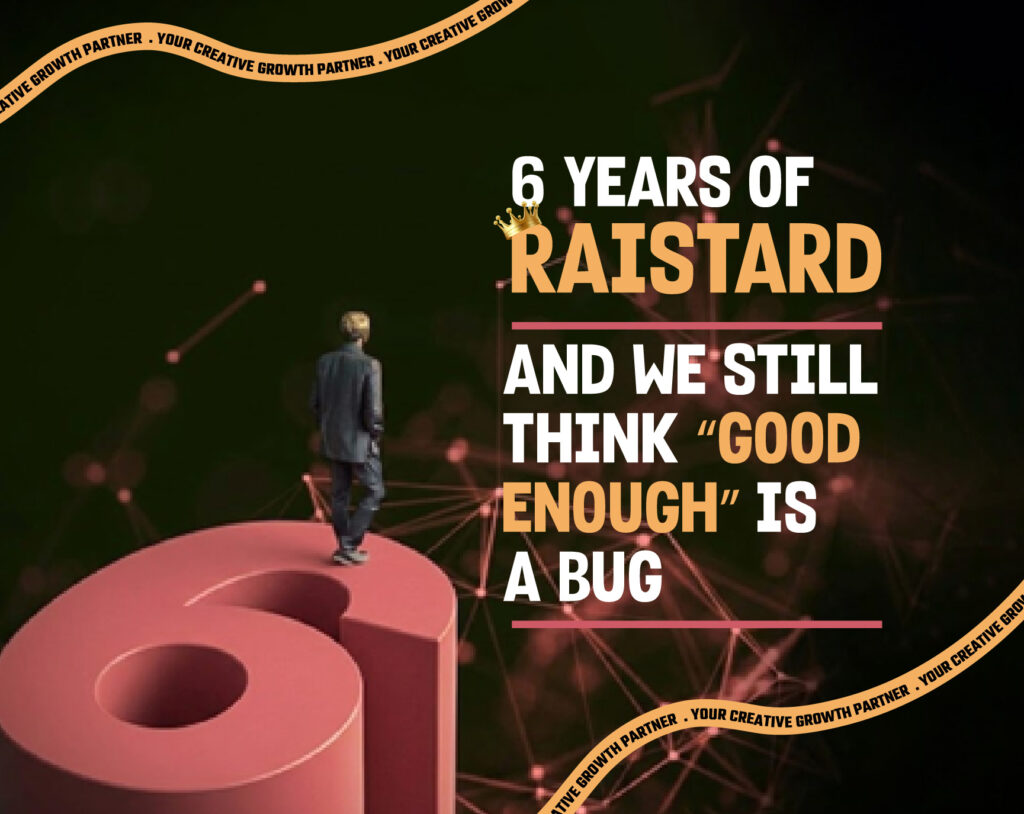
Six years sounds simple when you say it fast. Like a milestone. Like a LinkedIn update. Like a polite “thank you team” post with a cake and a logo.
Raistard was never polite.
Raistard started as a question that refused to sit still.
What if brands were not treated like posters, but like living systemsWhat if marketing was not decoration, but directionWhat if design was not style, but structureWhat if attention was not chased, but earned
Five years later, the answer is still the same. We are still building it.
Year 1 to Year 2. The First Version of Reality
Every agency starts with a myth. Ours was simple.
Make brands look better.
That version did not survive long.
We learned quickly that “looking better” is not a strategy. It is decoration without direction. A good logo can still sit on a dead brand. A beautiful post can still reach nobody. A website can still be ignored.
So we shifted from output to structure.
We started asking harder questions.
What does your audience already believe about youWhat do they feel before they read anythingWhere does attention drop in your funnelWhat is your real conversion behavior, not your assumed one
This is where Raistard stopped being a design service and started becoming a system.
Not a creative studio. A diagnostic machine that also designs.
Year 2 to Year 3. When Strategy Became the Product
Most agencies sell services.
We started selling clarity.
This is when we built the habit that defines Raistard today. Before any design, before any campaign, before any color palette discussion, we would break the brand into three questions.
Where are you right nowWhere should you beWhat is blocking the distance between the two
That gap became our workspace.
We stopped guessing. We started mapping.
We used research in a very simple way. Not academic, not heavy. Just honest.
What your audience actually does versus what you think they doWhat your competitors are saying versus what they are actually deliveringWhat your brand promises versus what it is actually communicating
This is also where content stopped being “posts” and became infrastructure.
Because content is not writing. Content is distribution of meaning.
A caption is not a line. It is positioning.A reel is not entertainment. It is retention.A blog is not text. It is search entry.
Once you understand that, everything changes.
Year 3 to Year 4. The Market Starts Talking Back
This is the stage where Raistard stopped being just an internal system and started becoming a visible pattern in the market.
We worked across industries that do not behave the same.
Fashion that sells identityFood that sells habitEducation that sells trustAutomotive that sells statusCorporate brands that sell stability
Each category forced us to adjust tone, structure, and logic.
This is where we built something we now call cultural calibration.
You do not force a brand into a style. You adjust the style to the audience’s reality.
This is also where meme marketing entered the system.
Not as humor. As language.
Memes became a shortcut for emotional recognition. A way to reduce friction between brand and audience. A way to say “we understand your world” without writing a paragraph.
We learned something important here.
Attention is not won by being loud. It is won by being recognized instantly.
Year 5 to Year 6. AI Entered the Room
When AI entered marketing, most people reacted in two ways.
Fear or hype.
We did neither.
We treated it like a tool with boundaries.
AI became part of our workflow in three areas.
First, speed.Drafting, variations, testing, structuring ideas.
Second, scale.Content systems, campaign versions, platform adaptations.
Third, exploration.Visual directions, early concept generation, tone mapping.
But we also learned where not to use it.
Human emotion still decides trust.Cultural sensitivity still needs lived understanding.Brand voice still needs human consistency.
So we built a rule.
AI accelerates work. Humans define meaning.
That balance became part of Raistard’s identity.
The Philosophy Layer. What Five Years Actually Built
After six years, agencies usually define themselves with words like creative, digital, or full service.
We stopped using those as identity.
Instead, we built internal principles.
Clarity before creativityStructure before styleContext before contentMeaning before execution
We also became obsessive about form.
The Golden Ratio is not a decoration idea for us. It is a reminder that balance exists in systems. When used correctly, it creates instinctive comfort in design. Not because people know math, but because they feel order.
We also respect design theory.
Gestalt principles for perceptionHierarchy for attention flowTypography for tone controlColor psychology for emotional direction
These are not academic references. They are working tools.
Platform Reality. Where We Actually Operate
Marketing in 2026 is not one platform. It is fragmentation.
We operate where attention moves.
Meta for structured targeting and conversion behaviorTikTok for trend velocity and discovery loopsSnapchat for short lived emotional engagementX for real time narrative and opinion flowDiscord for community depth and retentionBluesky for emerging decentralized conversation patternsVK for regional audience structures and alternative reach systems
Each platform is treated as a different behavior environment.
Same brand. Different psychology.
If your message does not adapt, it disappears.
The Real Work. What We Actually Do
After five years, we can describe Raistard in simple terms.
We take brands that are unclear and make them structured.
We take brands that are silent and make them visible.
We take brands that are visible and make them consistent.
This is done through a stack that includes:
Brand identity systemsContent frameworksSocial media architecturePaid campaign structuresWebsite experiencesUI and UX designSEO foundationsCommunity handling systemsChat based brand communication
Each layer connects to the next.
Nothing exists alone.
Talha Bin Zubair. The Brain Behind It
Raistard is not separate from its founder. It is shaped by how he thinks.
A mix of marketing discipline, field experience, and practical experimentation.
From SMS marketing systems in 2010To early e commerce in 2012To leadership roles in education institutionsTo training certifications and structured communication systemsTo brand campaigns across automotive, food, fashion, and media
The pattern is consistent.
Build systems. Test them in real environments. Improve them through repetition.
He does not treat branding as theory.
He treats it as behavior design.
Year 6 Reflection. What We Actually Learned
Five years in, we stopped believing in shortcuts.
Trends are temporary. Structure is not.
Virality is unstable. Consistency is not.
Attention is expensive. Trust is built.
We also learned something uncomfortable.
Most brands do not fail because of creativity.
They fail because of unclear identity.
So now our work always begins with one question.
What are you actually trying to be remembered for
2026. Year 7 of Raistard
Raistard is not finished.
It is not stable. It is not final. It is not packaged.
It is still evolving.
But one thing is consistent.
We still do not accept “good enough.”
We still rebuild brands from the ground up when needed.
We still treat design as decision making.
We still treat marketing as behavior shaping.
And we still believe this simple idea.
A brand is not what it says. It is what people repeat when you are not in the room.